
App Development
ControlNet: Revolutionizing Neural Control in AI Image Generation

ControlNet is a groundbreaking neural network architecture that adds spatial control to large, text-to-image diffusion models, such as Stable Diffusion or Seedream. While traditional generative models rely solely on text prompts—often leading to unpredictable compositions—ControlNet introduces a way to guide the structure of generated images using precise visual references, including depth maps, sketches, and human poses.
How ControlNet Works
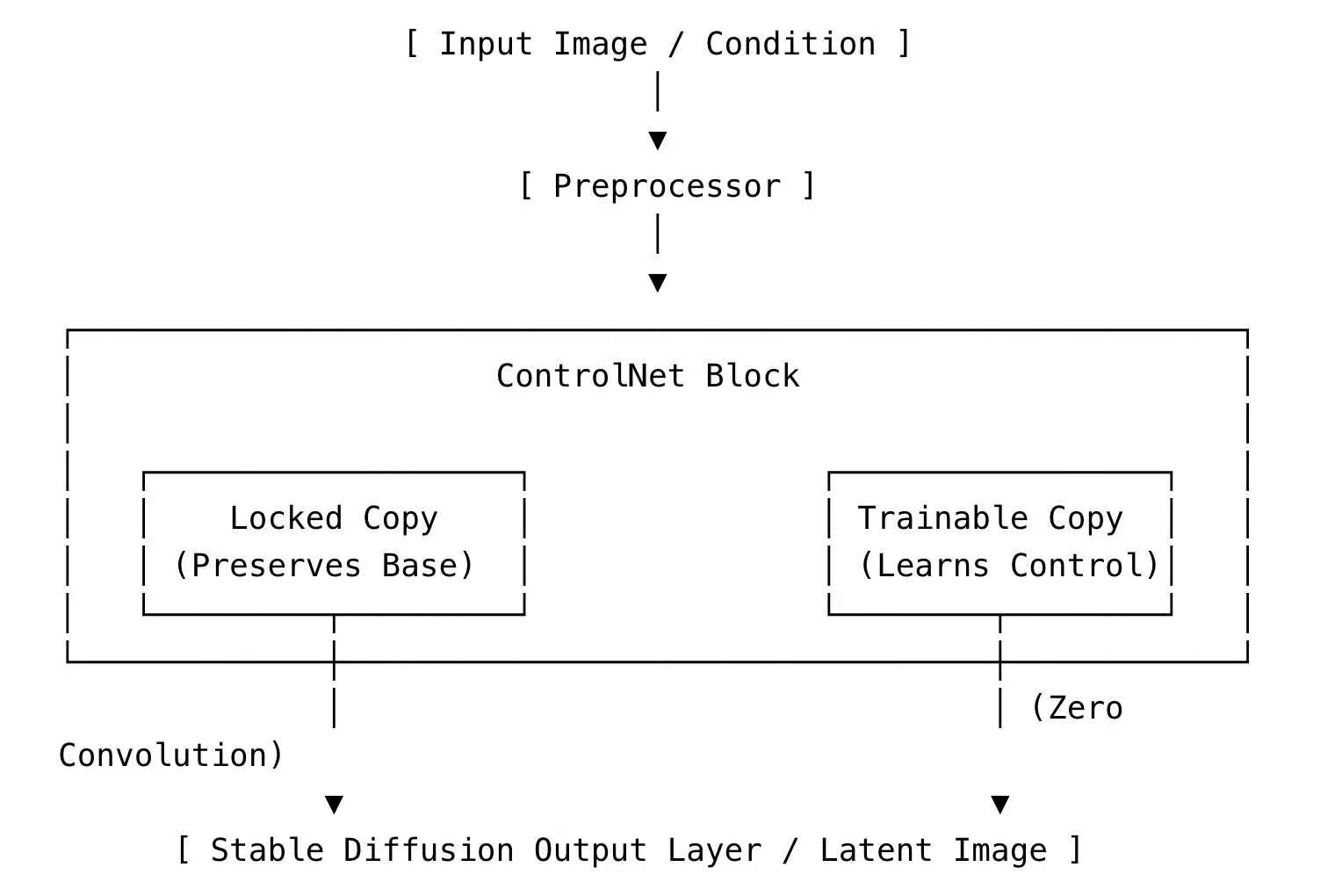
The key innovation of ControlNet lies in its ability to add conditioning inputs without destroying the foundational knowledge of the pre-trained diffusion model (end-to-end). It achieves this through a unique architecture:
                  [ Input Image / Condition ]
                               │
                               ▼
                        [ Preprocessor ]
                               │
                               ▼
┌─────────────────────────────────────────────────────────────┐
│                      ControlNet Block                       │
│                                                             │
│   ┌───────────────────┐               ┌─────────────────┐   │
│   │    Locked Copy    │               │ Trainable Copy  │   │
│   │ (Preserves Base)  │               │ (Learns Control)│   │
│   └─────────┬─────────┘               └────────┬────────┘   │
└─────────────┼──────────────────────────────────┼────────────┘
              │                                  │ (Zero Convolution)
              ▼                                  ▼
      [ Stable Diffusion Output Layer / Latent Image ]
- The Locked Copy: ControlNet duplicates the neural network blocks of the base model. The original weights are locked, preserving the model’s capability to generate high-quality images from text.
- The Trainable Copy: This duplicate clone is trained specifically to understand the new spatial conditioning parameters.
- Zero Convolutions: The trainable copy connects to the locked model via specialized layers initialized with zero weights. This ensures that no harmful noise or artifacts affect the model during the initial stages of training or inference.
Key ControlNet Models and Preprocessors
ControlNet processes input reference images using various preprocessors, each designed to extract a specific type of structural information:
1. Edge and Line Detection (Canny, Lineart, Scribble)
- What it does: Extracts outlines, fine lines, or rough hand-drawn strokes from an image.
- Best use case: Turning a black-and-white sketch, product mockup, or conceptual drawing into a fully rendered, photorealistic image while preserving the exact layout.
2. Human Pose Estimation (OpenPose)
- What it does: Detects the human skeleton, tracking key joints like heads, hands, shoulders, and fingers.
- Best use case: Perfecting character generation. It allows artists to replicate specific poses, gestures, or camera angles without relying on random prompt generations.
3. Depth Mapping (Depth)
- What it does: Generates a grayscale depth map where closer objects appear lighter and distant objects appear darker.
- Best use case: Maintaining 3D spatial awareness, object volume, and structural foreground/background relationships in scene composition.
4. Straight Line Detection (M-LSD)
- What it does: Extracts precise structural straight lines, discarding organic curves.
- Best use case: Ideal for architectural visualization, interior design renderings, and structural engineering layouts.
5. Semantic Segmentation (Segmentation)
- What it does: Color-codes an input image by object category (e.g., blue for sky, green for trees, red for buildings).
- Best use case: Giving the user exact control over object placement, ensuring that specific elements appear precisely where designated.
Main Advantages
- Precision over Randomness: Eliminates the frustration of “prompt roulette” by allowing creators to lock down the exact structural composition of an image.
- Efficient Training: ControlNet can be trained on relatively small datasets or individual consumer hardware, making it highly accessible to independent developers.
- High Synergy: Seamlessly integrates with custom checkpoints, LoRAs, and upscalers to enhance the final visual output.
===
Read more here:
- Zhang, Lvmin, Anyi Rao, and Maneesh Agrawala. 2023. “Adding Conditional Control to Text-to-Image Diffusion Models.” arXiv.Org. November 26. https://arxiv.org/abs/2302.05543.
- Uni-ControlNet: All-in-One Control to Text-to-Image Diffusion Models (2023)










Is it Possible to Make Money on Mining Farm in 2026?

DeepNude Market Report

Workplace Blacklisting Explained: 8 Popular FAQ
Niche Sites to Submit a Guest Post for Free in 2026
Best 4DX Movies List 2026
Is it Possible to Make Money on Mining Farm in 2026?