Solution Review
Blur Card – Crypto Cards with Hidden Fees

I used the service for about three weeks and spent a few hundred dollars through it. Since Blur Card is still pretty new and there isn’t much information about it online, I wanted to share my honest take.
The Blur Cards app does not provide enough transaction-level detail to verify whether these deductions are legitimate FX fees or undisclosed additional charges.
Crypto cards are usually marketed around three things: convenience, privacy, and low fees. BlurCards, a virtual crypto card that works through Telegram, appears to offer all three at first glance.
The official website is blurcards.com, and the service operates as a Telegram Mini App through the bot @BlurCards_bot. Account creation is almost instant because it uses your existing Telegram profile. There is no traditional registration process, no passport upload, no tax number, and no KYC procedure.
For people who care about financial privacy, that sounds attractive.
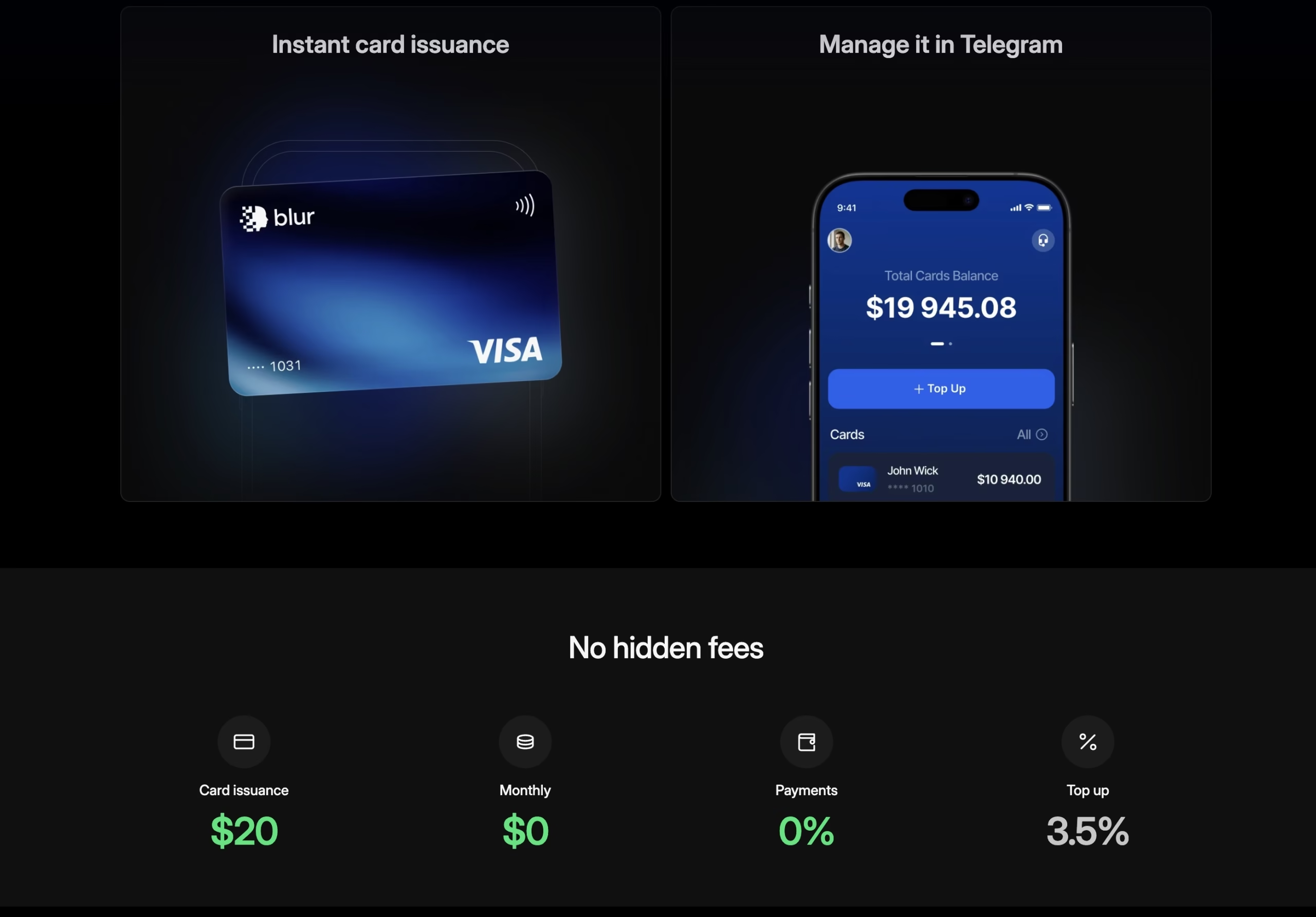
BlurCards also promotes a simple fee structure:
The virtual card costs $20 to issue.
There is no monthly account maintenance fee.
There is supposedly 0% transaction fee when paying for goods and services.
Top-ups cost $1 plus 3.8% of the transferred amount.
Deposits can be made in different cryptocurrencies, including USDT, BTC, ETH, and others. The actual card balance is held in USDT. The card is advertised as working on the Visa network, with support for Apple Pay and Google Pay.
On paper, this looks like a convenient no-KYC crypto card with clear and predictable costs.
Unfortunately, my real experience was different.
01 July ʼ26 Update: Yesterday, I contacted their support team and asked about the hidden fee. Unfortunately, I never received any response.
Today, my remaining balance was wiped out completely. In my case, that was $93.
Based on this experience, my conclusion is that the service may show accurate transactions for a while, but later applies additional hidden charges without warning or clear disclosure. And if you notice the issue and question it, there is a real risk that the remaining balance on your account may simply disappear.
For me, this is no longer just about hidden fees. It looks like the money was taken from my account without explanation.
The Hidden Fee Nobody Mentions
After using the card, I noticed that Blur Cards appears to charge an additional ~8.45% hidden fee from the card balance on every purchase.
This fee is not clearly disclosed in the app.
It is not explained on the website.
I could not find it in the platform’s rules or usage terms.
Based on the data they shared, this fee appears to be around 0.25% of the transaction amount and is applied when paying with the card through Apple Pay.
From the data support shared with me, it looks like this charge is roughly 2.9% per transaction and is applied when using the USD BlurCards card for non-U.S. payments — in my case, mostly regular purchases in Europe.
That is the main problem.
A fee is not necessarily bad if it is clearly stated upfront. Crypto cards often have higher fees than traditional bank cards because of conversion, liquidity, compliance, card issuing, and payment network costs. But users need to know the real cost before they deposit money and start spending.
In this case, the advertised fee structure creates the impression that spending with the card costs 0%, while the real-world cost appears to be much higher.
Why This Matters
The issue is not only that the card becomes expensive. The bigger problem is transparency.
If a service says there is a 0% transaction fee, but then deducts an additional 8.45% from the balance during each purchase, users are being misled about the actual cost of using the product.
That completely changes the economics of the card.
For example, the visible top-up fee is already $1 + 3.8% (on website says 3.5%—that’s another deception). If you then lose another 8.45% when spending, the real cost of using the card becomes extremely high.
That means the total effective fee can easily exceed 12%, depending on the amount topped up and spent.
At that point, the card is no longer a cheap or efficient payment tool. It becomes an expensive workaround.
Privacy Is Not Enough
One of the biggest selling points of BlurCards is that it does not require KYC. There is no passport verification, no tax ID submission, and no standard banking-style onboarding.
Because of this, spending and balance information is not automatically shared through tax-information exchange frameworks such as CRS or DAC8. For some users, especially those concerned about privacy, this is a major advantage.
But privacy alone does not make a product good.
A private financial tool still needs to be transparent, predictable, and honest about its fees. If the fee structure is unclear or incomplete, users cannot make an informed decision.
No-KYC should not mean no accountability.
The Real Cost of Using BlurCards
Based on the advertised pricing, users may expect to pay:
A one-time $20 card issuance fee
A top-up fee of $1 + 3.8%
No monthly fee
No transaction fee
But based on actual card spending, there appears to be an additional hidden deduction of around 8.45% on each transaction.
That makes the real cost much higher than advertised.
For casual users, this may not be obvious immediately. Small purchases can hide percentage-based losses. But once you start using the card regularly or spending larger amounts, the difference becomes impossible to ignore.
A card with a hidden 8.45% spending fee is not competitive. It is not “low fee.” And it is definitely not transparent.
My Main Concern
My concern is not that BlurCards charges money for its service. Every card provider has costs, and crypto payment infrastructure is not free.
My concern is that this specific fee appears to be hidden.
If BlurCards clearly stated: “We charge an additional 8.45% on every card purchase,” then users could decide whether the privacy benefit is worth the price.
But when a service advertises 0% transaction fees while deducting a significant amount during spending, that crosses a line.
It feels misleading.
Final Verdict
BlurCards may still be useful for people who specifically need a Telegram-based no-KYC virtual crypto card and are willing to pay a premium for privacy and convenience.
However, based on my experience, I cannot recommend it as a low-fee crypto card.
The advertised fees do not appear to reflect the real cost of using the card. The hidden 8.45% deduction on purchases makes the card much more expensive than it initially seems.
If you are considering BlurCards, check every transaction carefully. Compare your card balance before and after each purchase. Do not rely only on the fee information shown on the website or inside the app.
The idea behind the product is interesting. A simple no-KYC crypto card inside Telegram could be genuinely useful.
But hidden fees destroy trust.
Until BlurCards clearly discloses the full cost of using the card, including the apparent 8.45% charge on spending, users should be very cautious.
Update: Starting in July, BlurCards added Telegram chat notifications for all transactions. This means you can now see your payments directly in the chat, which makes the service somewhat more transparent than before. However, the extra charges for contactless payments and the cross-border fee still do not appear clearly in the standard transaction view. They are only visible if you contact support and ask them to request a detailed breakdown from the bank for your specific account.



The Best AI Tools to Remove Clothes from Images

Best 9 Free Deepnude Online Apps
222 App: The Swipe-Free Way to Meet People IRL in Los Angeles

Is it Possible to Make Money on Mining Farm in 2026?

DeepNude Market Report
The Best AI Tools to Remove Clothes from Images